Modular processing solutions · KHU Modular Upgrader
Built in America. Deployed where the oil is.
Processing capacity is tailored to each project and delivered as transportable modules, so upgrading can sit close to production, even in remote regions where conventional infrastructure is costly or impractical.
- Built
- Manufactured, assembled and tested in the USA
- Capacity
- Tailored to the project, train by train
- Shipped
- Road · sea · barge
- Installed
- At or near the field, including remote sites
- 1 Train · M01 + M02
- 2 Common pipe rack
- 3 Blend tank
From a US shop floor to a remote pad.
Modules are manufactured, assembled and tested in the United States before they are transported to the production location and installed. Most of the work happens under controlled conditions, so less of it happens in the field.
- 01
Manufacture
Structural skids, vessels and pipe spools built in a US fabrication shop.
- 02
Assemble
Equipment, piping, instruments and controls integrated on each skid.
- 03
Test
Factory acceptance testing before any module leaves the shop.
- 04
Transport
Shipped within a transportable envelope by road, sea or barge.
- 05
Install
Set on a prepared pad, connected and commissioned at the field.
Two modules. One complete process train.
A KHU train is two skid-mounted modules bolted end to end. Module 01 Conditioning carries the feed pumps and fired heater; Module 02 Conversion carries the reactor, effluent cooler, separator and controls. Capacity is scaled train by train, not by building a bigger plant.
Representative module. Proprietary engineering details, catalyst formulations and reactor design are not shown.
- Process equipment
- Reactor, heater, separation and transfer equipment, sized to the project.
- Piping & tie-ins
- Pipe spools and flanged tie-in points for fast interconnection at site.
- Instruments & controls
- Installed and checked in the shop, then reconnected in the field.
- Structure & lifting
- A steel skid frame with designated lifting points for handling and transport.
Upgrading without the central plant.
Conventional upgrading, such as delayed coking, concentrates capital in large facilities that are usually far from remote fields. A modular approach moves smaller, standardized capacity to where the crude is produced.
| Factor | Centralized upgrading | KHU modular upgrading |
|---|---|---|
| 01 · CapexCapital | CentralizedLarge, up-front investment in a single facility, such as a delayed coker. | KHU modularCapacity added train by train, matched to the project and phased with production. |
| 02 · LocationLocation | CentralizedSited where infrastructure already exists, often far from remote fields. | KHU modularInstalled at or near the field, close to production. |
| 03 · LogisticsLogistics | CentralizedHeavy crude and diluent moved long distances to the plant, and products moved back out. | KHU modularUpgraded product can serve as the blending component, so fewer inbound diluent shipments. |
| 04 · ScheduleSchedule | CentralizedLong construction programs, largely in the field. | KHU modularFabrication in a US shop runs in parallel with site preparation, with less work in the field. |
| 05 · GrowthScalability | CentralizedSized up front for forecast throughput. | KHU modularFurther trains can be added as production grows. |
Qualitative comparison. Outcomes depend on crude properties, project conditions and location.
Manufactured, assembled and tested in the USA.
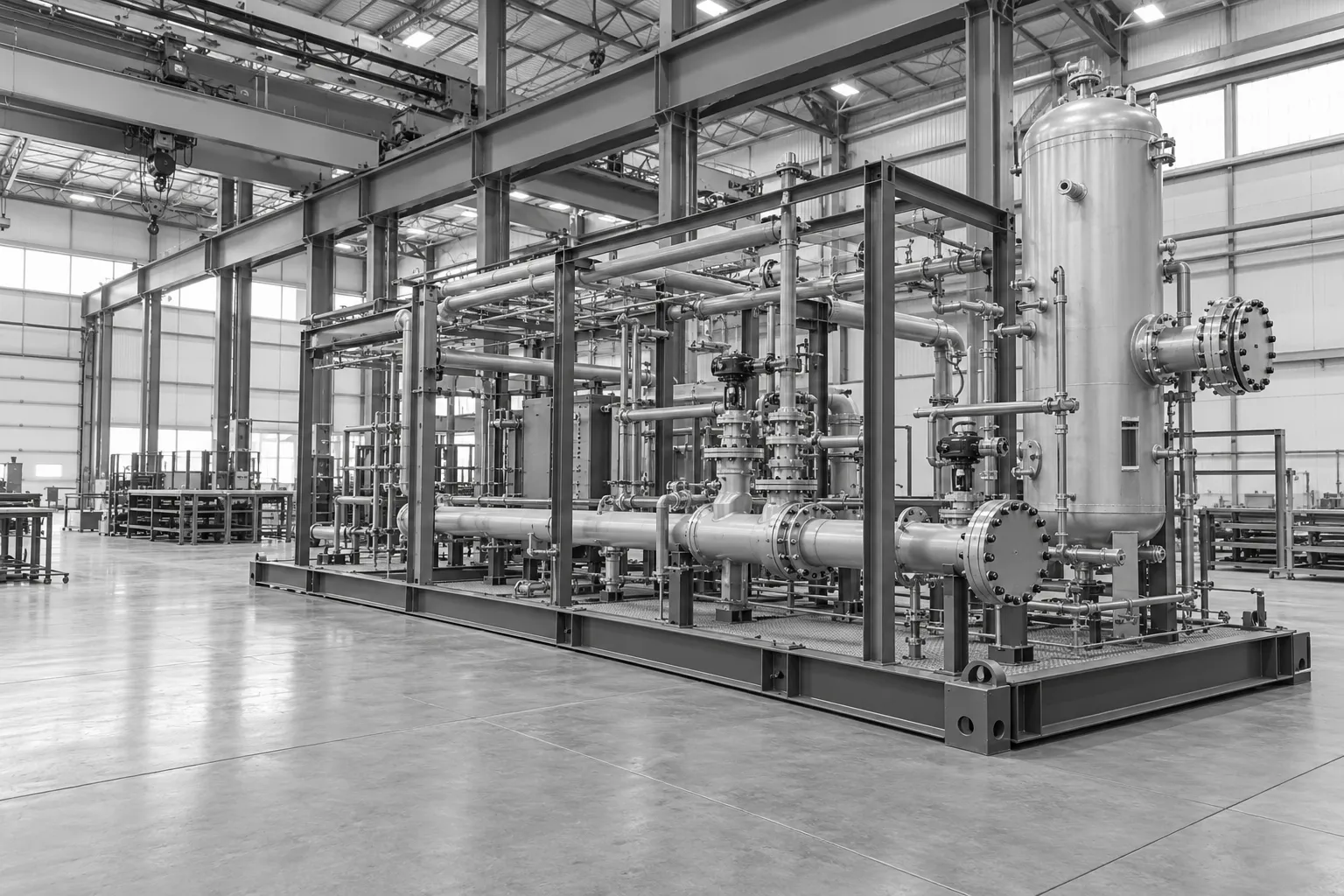
Building in a shop rather than in the field gives every module the same quality controls, the same trained crews and a predictable schedule, wherever it is going.
- A
Factory acceptance testing
Each module is tested before it ships, so issues are found on the shop floor, not at a remote site.
- B
Controlled conditions
Fabrication and assembly happen indoors, with consistent quality, safety and schedule control, independent of field weather.
- C
US supply chain
Steel, equipment and fabrication sourced through established US industrial supply chains.
- D
Codes and standards
Modules are designed and fabricated to recognised industry codes and standards, specified per project, with HSE requirements built into design, FAT and commissioning.
Shipped to remote environments. Installed at the field.
Modules are designed to a transportable envelope set by the route to site. Where the route or site access requires it, a module can be disassembled into transport units and reassembled at the field.
- Route
- Road, sea or barge, planned around the limits of each leg of the journey.
- Site
- The pad, foundations and tie-in points are prepared while modules are built.
- Install
- Modules are set, interconnected and commissioned, with Kalvera commissioning support.
- Remote
- Suited to locations where conventional infrastructure is costly or impractical.
- 1 Process module
- 2 Skid base
- 3 Lifting points
- 4 Heavy-haul unit
- Split line, where appropriate
-
RoadHeavy-haul to site
-
SeaOcean freight to port
-
BargeInland waterways
With you from feasibility to operations.
Kalvera works alongside producers, refiners and engineering firms through every stage of a modular project. Select a stage to see what happens and what you receive.
Stage 01 of 07
Feasibility
Under NDA, we review crude properties, site conditions and project economics, and outline what KHU could do for your barrels.
- Where
- With the client
- You receive
- A feasibility outline and next-step plan
Stage 02 of 07
Engineering
Process design, module layout and the interfaces with your facility or your engineering firm’s wider scope.
- Where
- Kalvera engineering, USA
- You receive
- A process and module design package
Stage 03 of 07
Fabrication
Skids, vessels, piping and instruments are built and assembled in a US shop under controlled conditions, while the site is prepared in parallel.
- Where
- United States
- You receive
- Fabricated, assembled modules
Stage 04 of 07
Factory acceptance testing
Each module is tested in the shop before shipment, so issues are found and resolved where it is fastest to fix them.
- Where
- United States
- You receive
- Tested modules, ready to ship
Stage 05 of 07
Transport
Logistics are planned around each leg of the route by road, sea or barge. Modules are disassembled where appropriate and reassembled at the field.
- Where
- USA to site
- You receive
- Modules delivered to the prepared pad
Stage 06 of 07
Installation & commissioning
Modules are set, interconnected and brought into operation, with Kalvera engineers supporting commissioning and start-up.
- Where
- At the field
- You receive
- An upgrading unit commissioned and in operation
Stage 07 of 07
Operations support
Technical support for operations, agreed per project, and further trains when production grows.
- Where
- At the field
- You receive
- Technical support agreed per project
Let’s size a module train for your field.
Share your crude properties, location and production plans. Our engineering team will outline how modular KHU capacity could fit your project. All discussions are under NDA.